Download our Complimentary Office Fit Out Guide - get yours now

Ensuring the mental and physical wellbeing of staff is key for successful hybrid working

With more employees heading back to the office for at least part of the week, employers are facing the challenge of creating a welcoming, safe environment that offers people a compelling reason to come in.

While many employees miss the social buzz of the office, research highlights they are also hesitant about returning to busy workspaces. At the same time, employers are considering how best to update the workplace and its work policies to help staff feel engaged and supported wherever they are working from. As staff return to the office, companies need to recognise the importance of health and wellbeing for long-term performance, so here are few ways companies can support their employees.

Ensuring workplace health and safety

Over half of the workforce remain concerned about the risk of continued COVID related infections in the office, clear hygiene measures help reassure employees that workplaces are clean and safe. Reassurance from visible frequent cleaning, one-way signage to help avoid clustering, spacious collaboration points, high-quality air filtration systems and softer screens between desks can all help people feel more secure about sharing workspaces. To avoid crowding at rush hours, some companies are staggering start and end times or giving employees the option of flexible hours.

Supporting employees’ mental health

Creating supportive work environments that help alleviate stress and burnout is more vital than ever, with employees reporting increased pressure when working in the office.

Building an inclusive environment where employees feel safe is essential for today’s workforce. Employees now expect their workplace to be a sympathetic place where they can share their difficulties and concerns. As well as redesigning workspaces for different work styles and offering places for relaxation – such as outdoor spaces or quiet room/reflection rooms, more employers are promoting wellbeing training to respond to mental health needs and providing easy-to-access support programs such as counsel and therapy whether in house or external.

Helping establish healthy routines

While many employees appreciate the flexibility of remote work in achieving a work/life balance, fewer than four in ten feel there is the same support for healthy routines in the office. A recent survey reported one third of employees do not have access to any health and wellbeing amenities however 70 percent of those that do will use them on a weekly basis. Some employers are introducing meeting-free Fridays to better manage weekly workloads while others are focusing their efforts on healthy food services, creating outdoors spaces and fitness spaces to allow employees to re-energise throughout the working day with some even providing activity trackers that can nudge and encourage healthy behaviour. Trusting employees to define their own work patterns and take care of their wellbeing during the working day benefits everyone, people are more engaged and energetic, and businesses gain from higher performance.

Recognising and rewarding employees’ efforts

Acknowledging hard work not only improves job satisfaction, spurs innovation and creates initiative, it equally supports mental wellbeing. What’s key is that employers provide recognition that staff find meaningful. An employee value proposition survey can help employers understand what employees want or need, finding the right thing that will really have influence on their wellbeing, whether that’s the working environment, free healthy snacks or time off to recharge.

Reconnecting employees to the company vision

Remote work has led to many employees feeling isolated and disconnected. Only one third of employees say they have maintained high-quality interactions with colleagues out of the office – with knock-on effects for how they feel about their work.

Employers are boosting staff engagement by investing in workplace culture – from holding social events to creating collaborative, tech-enabled workspaces that support seamless connections with both in-office and remote colleagues. By helping their staff engage again, employers stand to gain from employees who feel more fulfilled and empowered and who understand how their work is intrinsically linked to their organisation’s purpose and this will come back in greater innovation, productivity, and business growth.

Our Senior Designer Corneluis Lourens speaks to Insider Media about his observations on some the new occurrences in office design and concepts to be thinking about for the future of the workplace.

Head over to their website to have a read.

This month we sat down with Marita Price, Founder of Hello Performance and all-round workplace culture expert who discussed the future of working from home, the importance of company culture and tips to improve the culture in your team.

How has working from home impacted workplace culture?

Working from home brings many advantages as employees gain flexibility, avoid long commutes (which has shown to impact job satisfaction) and also remain free from office distractions. Businesses reduce costs on office space which can be considerable in larger cities and opens up the possibility to employ talent from further afield.

However, what we see is that it makes it difficult for organisations to create and solidify their company culture. Company culture is fostered, in large part, by face to face interactions whether its meetings, one to ones, corridor chats or team building activities. So remote teams make strengthening a company culture more difficult to accomplish.

How important is company culture?

We have heard the statement “Culture eats strategy for breakfast” – Even though personally I believe you need both, in equal amounts. A culture can certainly make or break companies, if we recall the Enron Scandal of 2001 which was the epitome of a company culture leading to demise of a Wall Street corporation.

Developing a company culture isn’t just something to be done for its own sake; it has meaningful impact on employee retention, satisfaction, and productivity. The reason for this is simple: When employees clearly identify with a company’s values, they’re more likely to engage with their work, and engagement is key in today’s workplace.

So, what is the future of working from home?

Even though in the UK, employers expect the proportion of regular home workers to double, from 18% pre-pandemic to 37% post pandemic1 a large percentage of companies are moving to a ‘Hybrid’ approach. Hybrid work tends to include more freedom around when to work as well as where.

One approach to hybrid working that was common, even prior to the pandemic, is designated days in the office for collaboration type meetings and then home working for the more individual focused tasks. This approach considers that physical presence is valuable and will accelerate orientation, team building and a project kick off for example but is not necessarily critical for all tasks.

Nicholas Bloom, a Stanford University economics professor with expertise in remote work believes that that working from home 2 days a week will be optimal for balancing collaborative and quiet work while benefitting the reduced stress of less commuting.2

Some companies are going further. Kissflow, a provider of digital workplace services with offices in the US and India, has introduced a mixed working model called REMOTE+. This combines three weeks of working from wherever you choose with one week of office-based work. The company covers accommodation costs for the office week and then encourages employees to return home for the rest of the time. 3 

How does face to face interactions support workplace culture?

Face to face can overcome the 4 key challenges we come across as we support remote working companies to strengthen their culture:

  1. Face to face prevents colleagues and teams being siloed from each other – Culture is the unwritten “its how we do things around here”. When new (or longer term) employees are continuously exposed to the behaviour of their colleagues, they’re able to grasp the standards of performance and communication much more quickly than they would remotely. This is the core of a culture. Positive behaviour breeds positive behaviour so face to face just accelerates this process and can bring you closer to your aspirational culture sooner. One idea that has arisen is modularisation, where an employees tasks are divided into collaboration tasks which should be done face to face and then individual tasks which can be more easily achieved working alone.  
  • Face to face reduces the feeling of isolation – Though working from home can make life easier at first, it can be detrimental to employees’ mental health. Humans are social creatures and working without seeing anyone can make employees feel cut off. Remote working can also cause anxiety. A recent study concluded that the lack of close contact hinders the formation of trust, connection, and mutual purpose, three key ingredients in any effective working relationship. Second, social interaction is strongly correlated with workplace engagement and satisfaction. A Gallup study4 surveying more than 15 million employees indicated that those with a “best” work buddy are “seven times as likely to be engaged in their jobs, are better at engaging customers, produce higher quality work, [and] have higher well-being,” compared to those without
  • Face to face make it easier to create enthusiasm for building & growing – You want employees to be passionate about the work they’re doing. Inspiring passion across a dispersed team is not impossible, but certainly not easy. Unless your employees are 100 percent intrinsically motivated, it’s difficult to stimulate enthusiasm about your service or product without ample social engagement—high spirits are tough to express digitally. Face to face can certainly be smartly used to develop that enthusiasm.  
  • Face to face reduces conflict – Conflict is more likely with digital communication, partly because our social inhibitions are more powerful when dealing with people face to face. Face to face can also support a feeling shared social identity which promotes team effectiveness and performance. This is more difficult with distributed remote teams which can impair trust and team spirit. 

Top tip to improve the culture in your company or team?

The top tip we preach is MEASURE MEASURE MEASURE  – find out where employees are at! The old mantra of “what get measured get managed” is very true here. A regular cross company survey will identify how engaged employees are and which areas are strong and which need to be improved.  This allows leadership teams to select a key area of focus that the company can commit to improving. Taking a regular temperature check (a ‘Culture Pulse’ in our language) allows you to see if the action you are spending time and resources on is having the impact you need.

“A culture will form no matter what you do, so you can either influence it or take your chances”. By measuring it, this is the first step to identifying what actions needs to be taken to so you can consciously lead the culture in the direction you need to achieve that strategy!

What should an organisation consider when redesigning their space to support the workplace culture?

The design of a company’s office can cater for many of the aspects of their culture they’re trying to promote. Wanting to create an autonomous and free-thinking culture? Provide various workstations for different purposes to allow activity-based working. Wanting to foster a culture of caring about your team’s wellbeing? Adorn the space with plant life, good lighting, and spaces to relax and break-out in. Wanting to create a culture of pride and belonging? Celebrate your business achievements, the brand and the qualities of the people who make up your teams as part of the design. It’s also important to have the right technology and AV equipment within an office to allow people working from home to feel like they can still have a presence in the office, albeit virtually. This helps to promote a culture of inclusivity.

Your surroundings impact your wellbeing, performance and overall engagement. Companies should consider what the space is being used for, what the aspirational culture they are trying to create and what do the employee wants. Creating environments which foster collaboration and interaction is key going forward.

  1. https://www.cipd.co.uk/about/media/press/home-working-increases
  2. https://www.bbc.com/worklife/article/20200710-the-remote-work-experiment-that-made-staff-more-productive
  3. https://kissflow.com/news/kissflow-launches-remoteplus/
  4. https://news.gallup.com/businessjournal/127043/friends-social-wellbeing.aspx

Since businesses have started planning their return to the office, we’ve been supporting a number of clients in helping them understand how to begin shaping a workspace strategy.

This can be a complex process at the best of times, but with so much uncertainty in how members of the team will use the workplace moving forward, companies are finding themselves asking more and more questions.

We’ve formulated a simplified starting point, as overcomplicating matters in the first instance can make planning a project feel overwhelming. As a fun test, we did this ourselves regarding our own office, and it even helped us highlight our needs and requirements and any changes that have occurred.

Before the pandemic struck…

  • For what *reasons did you need an office?
  • Who were the *users, and what did they do?
  • What *facilities did you need in the office to support the functions of the users?

Following the pandemic and planning for the future…

  • For what *reasons do you need an office?
  • Who are the *users, and what do they do?
  • What *facilities do you need in the office to support the functions of the users?

*Reasons: Community, space to do business, collaboration for staff, validation of business credentials, client perception/confidence, staff retention, security of intellectual property, knowledge sharing, communication within business, attracting top talent, employee support, creating positive culture, because it is the accepted way, future proofing, training, producing/creating product   

*Users: Team members, junior through to senior levels, full-time, part-time, departments, staff from other office locations, visitors, clients, suppliers, contractors, business partnerships

*Facilities: Quiet lone working desks, general working desks, enclosed meeting rooms – formal and informal, open meeting spaces – formal and informal, project spaces, collaborative areas, video conference requirements, break out spaces, library area, soft seating areas, printer stations, reception area, visitor/client area, hot desking (short and long stay), touch down areas, storage areas

Through working with clients recently, we have produced some useful design resources and a more in-depth look at further questions and considerations to be discussed when planning for an office design and fit-out project. If you’d like to receive the resources we’ve created, please answer the questions above and return to hello@amh-projects.co.uk and we’ll send them out to you.

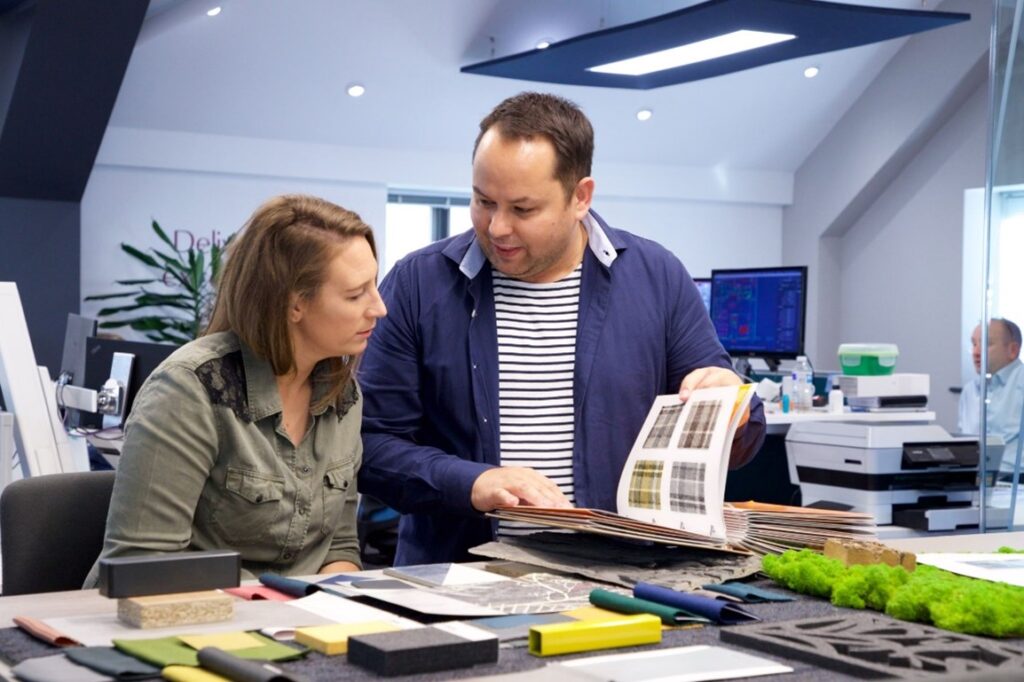
During the ‘Create’ stage our our design and fit-out process we always endeavour to to provide a number of design solutions for the client to choose from.

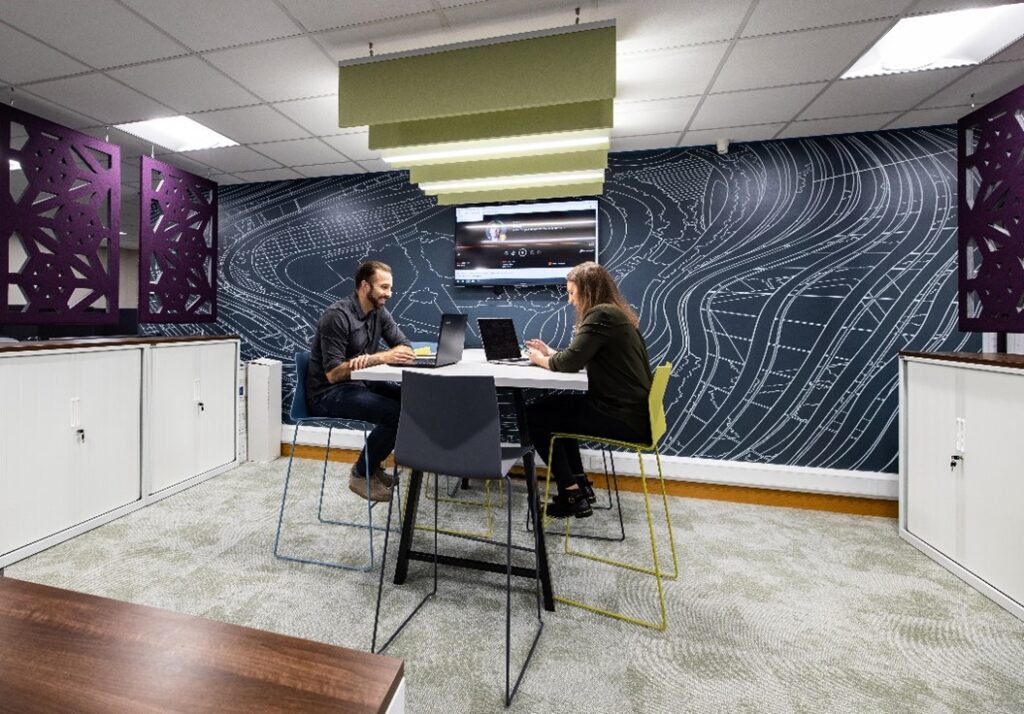
In recent times there has been an increase in the demand for effective collaboration and meeting spaces as teams focus more on being creative and innovative together on the days that they are in the office.

Each solution will offer a slightly different benefit and have somewhat alternative functions to how the space can be used and for what reason. This demonstrates the need for the in-depth research and analysis which we conduct during the ‘Explore’ phase of working with a client as we’ll be able to identify in the various needs and requirements and offer the most appropriate design concepts based on that information.

Every element of our design is thought about and have reasoning behind them to help you achieve the objectives of your workspace project. We provide direction on furniture for comfort and functionality, furnishings for aesthetics, workplace solutions such as acoustics to reduce noise pollution, storage solutions to maximise your space, all in a manner which fits with your budget.

If you have a workspace design project that you would like to discuss with the team, then please get in contact on 0117 231 0077 and watch how your ideas are brought to life!